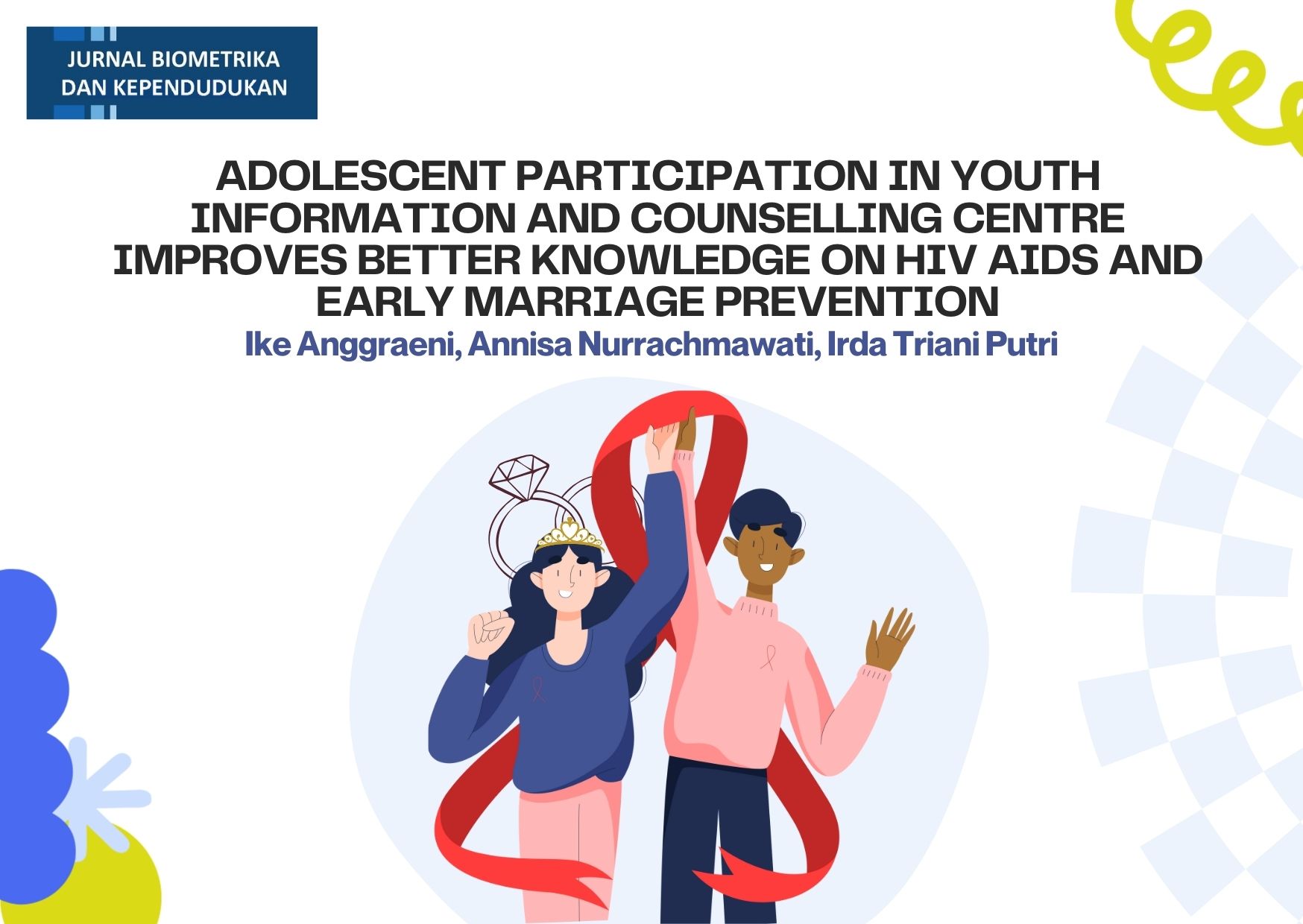
ADOLESCENT PARTICIPATION IN YOUTH INFORMATION AND COUNSELLING CENTRE IMPROVES BETTER KNOWLEDGE ON HIV AIDS AND EARLY MARRIAGE PREVENTION

Downloads
Youth Information and Counseling Centers (YICC) im to enhance adolescents’ reproductive health knowledge through peer-based education. Despite their significance, the effectiveness of such programs remains inadequately evaluated, especially in Indonesia, where adolescent reproductive health challenges, such as early marriage and HIV/AIDS, persist. This study explores the relationship between YICC participation and adolescents’ knowledge of HIV/AIDS and early marriage prevention in East Kalimantan. A cross-sectional survey was conducted among 830 adolescents aged 10-24 using a validated online questionnaire. Descriptive statistics, Kruskal-Wallis tests, ANCOVA, and logistic regression were employed to analyze knowledge differences and predictors, controlling for sociodemographic factors. Results revealed that 71.8% of adolescents were aware of YICC, yet only 38.2% participated in its activities, and 21.4% were formal members. YICC participants showed significantly greater knowledge of HIV/AIDS and the ideal marriage age (p < 0.01), though no significant differences were found in attitudinal scores. ANCOVA indicated that YICC participation was an important predictor of knowledge, even after adjusting for parental education, internet access, and residence. Logistic regression further showed that YICC participants were 1.9 times more likely to possess high knowledge compared to non-participants (AOR = 1.90; 95% CI: 1.30-2.70; p = 0.001). Key predictors of higher knowledge included parental education, internet access, and urban residence. These findings highlight the importance of increasing YICC participation and integrating digital and school-based strategies to enhance adolescent reproductive health education.
Kyilleh JM, Tabong PTN, Konlaan BB. Adolescents’ reproductive health knowledge, choices and factors affecting reproductive health choices: A qualitative study in the West Gonja District in Northern region, Ghana. BMC Int Health Hum Rights [Internet]. 2018;18(1):1–12. Available from: https://doi.org/10.1186/s12914-018-0147-5
Kemi B, Christian O, Alabi JA, Isola O. Unplanned Parenthood: The Socio-Economic Consequences of Adolescent Child-bearing in Nigeria. J Educ Pract [Internet]. 2015;6(31):15–8. Available from: https://www.iiste.org/Journals/index.php/JEP/article/view/27292
Ngum Chi Watts MC, Liamputtong P, McMichael C. Early motherhood: A qualitative study exploring the experiences of African Australian teenage mothers in greater Melbourne, Australia. BMC Public Health [Internet]. 2015;15(1):1–11. Available from: https://doi.org/10.1186/s12889-015-2215-2
Mangeli M, Rayyani M, Cheraghi MA, Tirgari B. Exploring the Challenges of Adolescent Mothers From Their Life Experiences in the Transition to Motherhood: A Qualitative Study. J Fam Reprod Heal [Internet]. 2017;11(3):165–73. Available from: http://www.ncbi.nlm.nih.gov/pubmed/30018654%0Ahttp://www.pubmedcentral.nih.gov/articlerender.fcgi?artid=PMC6045691
Morris JL, Rushwan H. Adolescent sexual and reproductive health: The global challenges. Int J Gynecol Obstet [Internet]. 2015;131:S40–2. Available from: http://dx.doi.org/10.1016/j.ijgo.2015.02.006
Rofiq A. Pusat Informasi dan Konseling Remaja: Upaya Perwujudan Pendidikan Nonformal. Diklus J Pendidik Luar Sekol [Internet]. 2019;3(2):73–84. Available from: https://doi.org./10.21831/diklus.v3i2.27026
Qomariah S. Pacar Berhubungan dengan Perilaku Seks Pranikah pada Remaja. J Kesmas Asclepius [Internet]. 2020;2(1):44–53. Available from: https://doi.org/10.31539/jka.v2i1.585
Asmin E, Kistiana S. Faktor pendukung perilaku seksual remaja di provinsi maluku (Analisis data SKAP) remaja 2019). Bul Penelit Sist Kesehat [Internet]. 2021;24(3):226–34. Available from: https://doi.org/10.22435/hsr.v24i3.4281
National Population and Family Planning Board. Survei Demografi dan Kesehatan Reproduksi Remaja 2017 [Internet]. National Population and Family Planning Board. 2017. p. 1–606. Available from: http://www.dhsprogram.com.
National Family Planning Coordinating Agency, USAID, Central Bureau of Statistik, Indonesia Ministry Of Health. Indonesia Demography and Health Survey 2017. Jakarta; 2018.
Nursal DGA, Mardatillah M, Pratiwi SD. Pemanfataan Pusat Informasi dan Konseling Remaja (PIK-R) Oleh Remaja di SMK Kota Padang Tahun 2020. IAKMI J Kesehat Masy Indones [Internet]. 2020;1(3):111–20. Available from: http://jurnal.iakmi.id/index.php/IJKMI/article/view/115
Brenner PS. Effects of Nonresponse, Measurement, and Coverage Bias in Survey Estimates of Voting. Soc Sci Q. 2021;102(2):939–54.
Sawilowsky SS, Fahoome G. Kruskal‐Wallis Test: Basic. 2014;
McKight PE, Najab J. Kruskal‐Wallis Test. 2010;1.
Pinto R, Silva L, Valentim R, Kumar V, Gusmão C, Oliveira CA, et al. Systematic Review on Information Technology Approaches to Evaluate the Impact of Public Health Campaigns: Real Cases and Possible Directions [Internet]. Vol. 9, Frontiers in Public Health. 2022. Available from: https://doi.org/10.3389/fpubh.2022.890586
Weidman AC, Levinson CA. I’m still socially anxious online: Offline relationship impairment characterizing social anxiety manifests and is accurately perceived in online social networking profiles. Comput Human Behav [Internet]. 2015;49:12–9. Available from: http://dx.doi.org/10.1016/j.chb.2014.12.045
Taba M, Allen TB, Caldwell PHY, Skinner SR, Kang M, McCaffery K, et al. Adolescents’ self-efficacy and digital health literacy: a cross-sectional mixed methods study. BMC Public Health [Internet]. 2022;22(1):1–13. Available from: https://doi.org/10.1186/s12889-022-13599-7
Fitriana H, Siswantara P. Pendidikan Kesehatan Reproduksi Remaja Di SMPN 52 Surabaya. Indones J Public Heal [Internet]. 2019;13(1):110. Available from: https://doi.org/10.20473/ijph.v13i1.2018.110-121
Dodd S, Widnall E, Russell AE, Curtin EL, Simmonds R, Limmer M, et al. School-based peer education interventions to improve health: a global systematic review of effectiveness. BMC Public Health [Internet]. 2022;22(1):1–13. Available from: https://doi.org/10.1186/s12889-022-14688-3
Moreira MT, Rocha E, Lima A, Pereira L, Rodrigues S, Fernandes CS. Knowledge about Sex Education in Adolescence: A Cross-Sectional Study. Adolescents [Internet]. 2023;3(3):431–45. Available from: https://doi.org/10.3390/adolescents3030030
Nuraisyah F, Matahari R, Isni K, Utami FP. Pengaruh Pelatihan Kesehatan Reproduksi Remaja terhadap Pengetahuan dan Sikap Orang. J Ilm Kesehat [Internet]. 2021;20(1):34–9. Available from: https://doi.org/10.33221/jikes.v20i1.869
Dowshen N, Lee S, Matty Lehman B, Castillo M, Mollen C. Feasibility of a Youth-Driven Social Media Campaign to Promote STI and HIV Testing Among Adolescents in Philadelphia. AIDS Behav [Internet]. 2015;19:106–11. Available from: https://doi.org/10.1007/s10461-014-0971-4
Yusnita M. Relationship between Social Media Exposure and Adolescents’ Knowledge, Attitude and Behaviour to HIV/AIDS Prevention. J Komun Indones [Internet]. 2021;X(1):42–53. Available from: https://doi.org/10.7454/jkmi.v10i1.1019
Setiawan H. Literature Review: Utilization of Social Media as Education and Promotion Media of HIV in Adolesence. IAKMI Public Heal J Indones [Internet]. 2021;2(1):1–6. Available from: http://jurnal.iakmi.id/index.php/IPHJI/article/view/132
Efevbera Y, Bhabha J. Defining and deconstructing girl child marriage and applications to global public health. BMC Public Health [Internet]. 2020;20(1):1–11. Available from: https://doi.org/10.1186/s12889-020-09545-0
Hertika PM, Sulistyorini L, Wuryaningsih EW. Hubungan Pernikahan Usia Dini dengan Risiko Tindak Kekerasan oleh Ibu pada Anak Usia Prasekolah di Kelurahan Sumbersari Kecamatan Sumbersari Kabupaten Jember (The Relation between Early Marriage and the Risk of Abusing by Mothers Towards her Preschoolers. Pustaka Kesehat [Internet]. 2017;5(3):481–8. Available from: https://jurnal.unej.ac.id/index.php/JPK/article/view/6139/4548
Shrestha R, Karki P, Copenhaver M. Early Sexual Debut: A Risk Factor for STIs/HIV Acquisition Among a Nationally Representative Sample of Adults in Nepal. J Community Heal [Internet]. 2016;41:1–16. Available from: https://doi.org/doi:10.1007/s10900-015-0065-6.
Fadlyana E, Larasaty S. Pernikahan Usia Dini dan Permasalahannya. Sari Pediatr [Internet]. 2016;11(2):136. Available from: https://doi.org/10.14238/sp11.2.2009.136-41
Sri Madinah, M. Zen Rahfiludin SAN. Pengaruh Pendidikan Kesehatan Reproduksi Thd Tingkat Pengetahuan Tentang Pendewasaan Usia Perkawinan. J Kesehat Masy [Internet]. 2017;5(1):332–40. Available from: http://ejournal-s1.undip.ac.id/index.php/jkm%0APENGARUH
Marliania R, Sakinahb AM, Royanulloha, Azizahac N. Effects of Genre Program on Youth Knowledge , Attitude ,. Malaysian Online J Couns [Internet]. 2018;5(1):11–34. Available from: http://mojc.um.edu.my
Oktriyanto O, Amrullah H, Hastuti D, Alfiasari A. Persepsi tentang Usia Pernikahan Perempuan dan Jumlah Anak yang Diharapkan: Mampukah Memprediksi Praktek Pengasuhan Orang Tua? J Ilmu Kel dan Konsum [Internet]. 2019;12(2):145–56. Available from: https://doi.org/10.24156/jikk.2019.12.2.145
Sanjiwani NMGA, Rismawan M, Wulansari NT. Hubungan antara partisipasi siswa dalam pusat informasi dan konseling remaja dengan sikap pendewasaan usia perkawinan siswa sma di kota denpasar. Berk Ilm Mhs Ilmu Keperawatan Indones [Internet]. 2022;10(1):11–7. Available from: https://doi.org/10.53345/bimiki.v10i1.197
Dadi TK, Feyasa MB, Gebre MN. HIV knowledge and associated factors among young Ethiopians: Application of multilevel order logistic regression using the 2016 EDHS. BMC Infect Dis [Internet]. 2020;20(1):1–11. Available from: https://doi.org/10.1186/s12879-020-05436-2
Aybar-Flores A, Talavera A, Espinoza-Portilla E. Predicting the HIV/AIDS Knowledge among the Adolescent and Young Adult Population in Peru: Application of Quasi-Binomial Logistic Regression and Machine Learning Algorithms [Internet]. Vol. 20, International Journal of Environmental Research and Public Health. 2023. Available from: https://doi.org/10.3390/ijerph20075318
Copyright (c) 2025 Jurnal Biometrika dan Kependudukan

This work is licensed under a Creative Commons Attribution-NonCommercial-ShareAlike 4.0 International License.
Copyright©2022 Jurnal Biometrika dan Kependudukan (Journal of Biometrics and Population)
This work is licensed under a Creative Commons Attribution-NonCommercial-ShareAlike 4.0 International License.
1. Copyright of all journal manuscripts is held by the Jurnal Biometrika dan Kependudukan.
2. Formal legal provisions to access digital articles of the electronic journals are subject to the provision of the Creative Commons Attribution-ShareAlike license (CC BY-NC-SA), which means that Jurnal Kesehatan Biometrika dan Kependudukan to keep, transfer media/format, manage in the form of databases, maintain, and publish articles.
3. Published manuscripts both printed and electronic are open access for educational, research, and library purposes. Additionally, the editorial board is not responsible for any violations of copyright law.