Environmental and Management Risk Factors for Goat Mastitis in Banyuwangi

Downloads
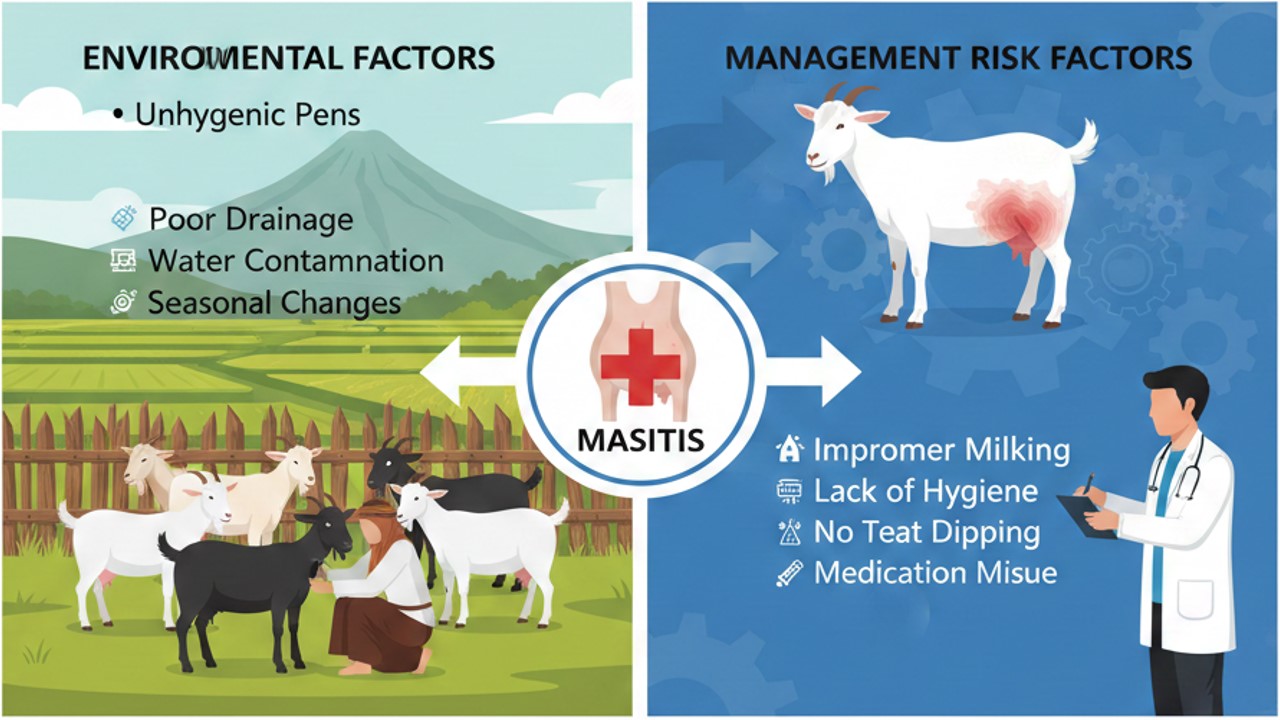
Mastitis is a persistent and economically significant health problem in dairy goats in Banyuwangi, East Java, where smallholder production systems dominate. This review synthesises current evidence on the primary risk factors contributing to the high prevalence of subclinical mastitis in the region. Local studies consistently report Staphylococcus aureus as the leading etiological agent, frequently exhibiting antimicrobial resistance linked to unsupervised antibiotic use. Host-related factors such as advanced parity, udder lesions, and teat-end damage increase susceptibility to intramammary infection. Management practices—including inadequate milking hygiene, use of shared towels, absence of pre- and post-dipping, and irregular equipment sanitation—facilitate the transmission of contagious pathogens. Environmental conditions, particularly high humidity and poor housing sanitation, further elevate infection pressure. Socio-economic constraints and limited farmer knowledge about subclinical mastitis and antibiotic stewardship exacerbate disease persistence. The multifactorial nature of mastitis in Banyuwangi underscores the need for context-appropriate interventions combining improved hygiene practices, better housing management, routine screening, and responsible antimicrobial use. Strengthened farmer education and targeted surveillance are essential to reduce mastitis prevalence and enhance the sustainability of goat dairy production in the region.
Abebe, R., Hatiya, H., Abera, M., Megersa, B. and Asmare, K., 2021. Bovine mastitis: prevalence, risk factors and isolation of Staphylococcus aureus in dairy cows. Veterinary Medicine and Science, 7(2), pp.319–330.
Contreras, A., Sierra, D., Sánchez, A., Corrales, J.C., Marco, J.C., Paape, M.J. and Gonzalo, C., 2020. Mastitis in small ruminants. Small Ruminant Research, 118(1–3), pp.1–9.
Fatmawati, M.F., 2023. Epidemiological studies of subclinical mastitis in dairy goats in East Java, Indonesia. Jurnal Veteriner Indonesia, 24(2), pp.110–119.
Kebede, T., Tariku, S. and Zenebe, T., 2019. Prevalence and etiology of goat mastitis in pastoral areas of Ethiopia. African Journal of Microbiology Research, 13(15), pp.277–284.
Lobago, F., et al., 2018. Environmental determinants of mastitis in small ruminants. Tropical Animal Health and Production, 50(2), pp.321–330.
Nuraini, D.M., Hartono, M., and Wahyuni, R., 2023. Prevalence of mastitis in dairy animals in Indonesia: A systematic review. Veterinary World, 16, pp.1032–1041.
Praja, R.N., Yuniarti, W.M., Maslamama, S.T., et al., 2023. Antimicrobial resistance of Staphylococcus aureus isolated from raw goat milk with subclinical mastitis in Siliragung, Banyuwangi. Veterinary World, 16(5), pp.1023–1030.
Sharun, K., Dhama, K., Tiwari, R., Mohapatra, R.K. and Singh, R., 2021. Staphylococcal mastitis in small ruminants: an overview. Journal of Dairy Science, 104(4), pp.4007–4020.
Singh, M., et al., 2018. Risk factors associated with caprine mastitis in smallholder dairy farms. Indian Journal of Veterinary Research, 27(1), pp.50–56.
Sori, T., Bekana, M., Adugna, G. and Kelbessa, E., 2020. Prevalence and risk factors of caprine mastitis in Ethiopia. Tropical Animal Health and Production, 52(3), pp.1125–1133.
Tessema, G., et al., 2019. Antibiotic misuse in livestock: public health risks and mitigation strategies. One Health, 7, p.100–112.
Tibebu, A., 2025. Mastitis in goats: etiology, epidemiology and control. Journal of Veterinary Medicine Research, 42(1), pp.1–15.
Copyright (c) 2025 Dewi Sri Lestari, Boedi Setiawan, Amung Logam Saputro, Maslichah Mafruchati, Ratih Novita Praja, Ragil Angga Prastiya

This work is licensed under a Creative Commons Attribution-ShareAlike 4.0 International License.
Journal of Basic Medical Veterinary (JBMV) by Unair is licensed under a Creative Commons Attribution-ShareAlike 4.0 International License.
1. The journal allows the author to hold the copyright of the article without restrictions.
2. The journal allows the author(s) to retain publishing rights without restrictions
3. The legal formal aspect of journal publication accessibility refers to Creative Commons Attribution Share-Alike (CC BY-SA).
4. The Creative Commons Attribution Share-Alike (CC BY-SA) license allows re-distribution and re-use of a licensed work on the conditions that the creator is appropriately credited and that any derivative work is made available under "the same, similar or a compatible license”. Other than the conditions mentioned above, the editorial board is not responsible for copyright violation.



 Perhimpunan Dokter Hewan Indonesia