Leukocyte Profile Analysis in Cats with Otitis Caused by Otodectes cynotis Infestation Following Ivermectin Treatment

Downloads
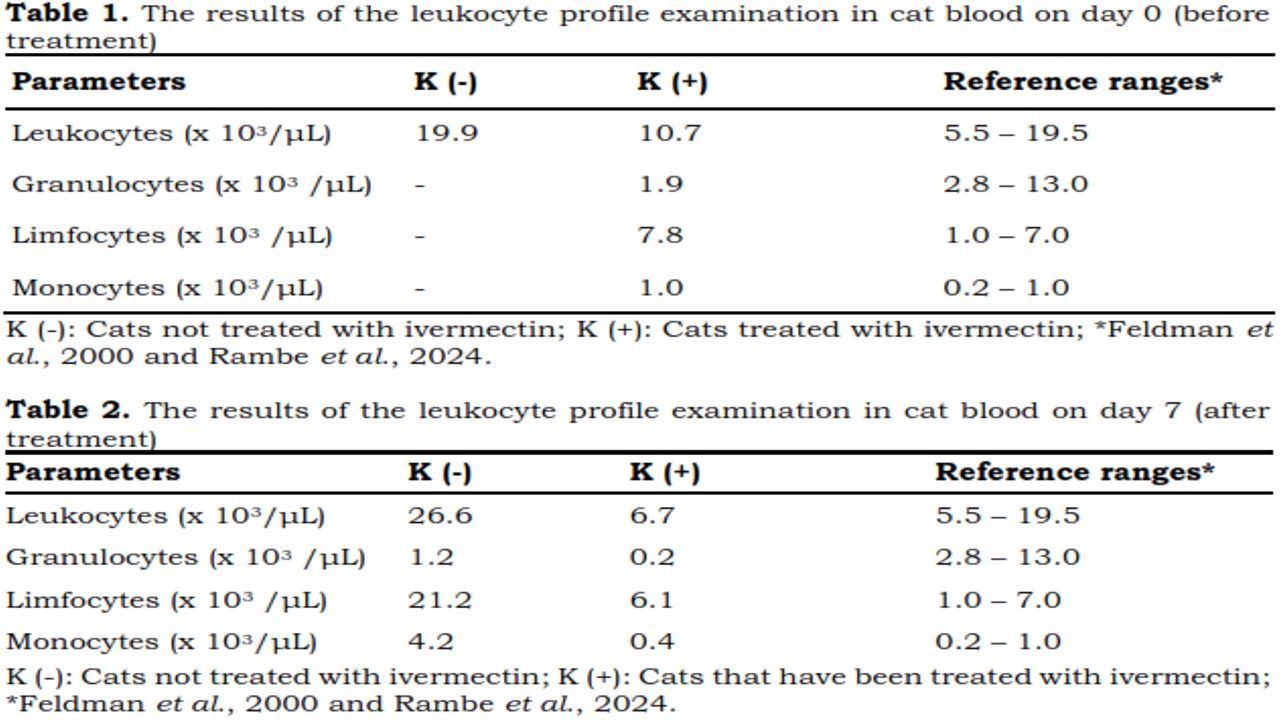
Otitis in domestic cats is an inflammation of the ear caused by bacterial, fungal, or parasitic infections, especially ear mites (Otodectes cynotis). It is common in cats and can cause itching, discomfort, and more severe secondary infections if left untreated. Ivermectin is an antiparasitic agent that is effective in controlling various parasitic infections, including ear mites in cats. The mechanism of action of ivermectin is by inhibiting the nerve activity of the parasite, causing paralysis and death of the parasite. This study aimed to evaluate the effectiveness of ivermectin therapy on leukocyte profile in cats with otitis due to ear mite Otodectes cynotis parasite infestation. This study used a Pretest-Posttest Control Group Design involving two groups of domestic cats: a treatment group (K+) receiving ivermectin therapy and a control group (K-) receiving no treatment. Leukocyte profiles were analyzed using a hematology analyzer. The results showed that ivermectin was effective in reducing the total leukocyte count. A decrease in the number of leukocytes, especially eosinophils and neutrophils, indicates an improvement in the inflammation and healing stage of the cat's body. Thus, ivermectin was shown to be effective in suppressing Otodectes cynotis parasite invasion and improving the immunological status of domestic cats through its effect on leukocyte profile.
Brown, P., Harris, J., & Miller, S. 2017. Efficacy and safety of ivermectin in the treatment of Otodectes cynotis infestation in cats. Journal of Feline Medicine and Surgery, 19(4):312-319.
Carter, B., & Young, L. 2019. Immunological responses in feline otitis: Evaluating leukocyte profiles before and after antiparasitic therapy. Veterinary Immunology and Parasitology Journal, 15(2):87-94.
Feldman BF, Zinkl JG, Jain NC, Schalm OW. 2000. Schalm's Veterinary Hematology. Lippincot Williams & Wilkins, Philadelphia (US).
Garcia, M., Torres, L., & Ramirez, J. 2020. Hematological responses to antiparasitic treatment in dogs and other companion animals. Journal of Veterinary Parasitology, 28(3):198-205.
Hall, J.E. 2011. Guyton and Hall Textbook of Medical Physiology. Edisi 12. Saunders Elsevier, USA.
Harrison, K., Bennett, R., & Cole, M. 2021. The effects of ivermectin on leukocyte profiles and immune response in parasitic infestations. International Journal of Veterinary Immunology, 34(2):112-120.
Jain, N.C. 1993. Essentials of Veterinary Hematology. Lea and Febiger, Philadelphia, 76-250.
Kartika, Y., Erina, & Nuzul. 2020. Profil darah kucing domestik (Felis domesticus) yang menderita ear mites. Jurnal Veteriner 15(3):124-130.
Latimer, K. S. 2011. Duncan and Prasse's Veterinary Laboratory Medicine: Clinical Pathology.
Mahindra, R., Patel, S., & Kumar, V. 2020. Hematological responses as indicators of immune defense in animals. Journal of Veterinary Immunology, 18(2):145-152.
Meyer, D. J., & Harvey, J. W. 2004. Veterinary Laboratory Medicine: Interpretation and Diagnosis.
Meyer, D., dan Harvey, J.W. 2004. Veterinary Laboratory Medicine. Elsevier Saunders, Missouri.
Mueller, R. S., & Bettenay, S. V. 2015. Hematological effects of antiparasitic treatments in cats: Focus on leukocyte profile alteration. Veterinary Record, 176(6):145-150.
Murray, R. K., Granner, Mayes dan Rodwell, V.W. 2003. Biokimia Harper. Edisi 25. Penerbit Buku Kedokteran EGC, Jakarta.
Muzaky, A. et al. 2021. Profil Darah Kucing Lokal (Felis catus) Selama Kesembuhan Distant Flaps. Jurnal Ilmiah Mahasiswa Veteriner (JIMVET), 5(3):114-123. Universitas Syiah Kuala: Fakultas Kedokteran Hewan.
Rambe, R. H., Razak, A., & Cahyanti, N. 2024. Profil darah pasien kucing (Felis catus) yang terkena leukopenia dan anemia di UPTD Rumah Sakit Hewan Sumatera Barat. Biocelebes, 18(1):1-9.
Ravintharan, M. 2018. Profil leukosit pada kucing penderita scabies [Skripsi]. Fakultas Kedokteran Hewan Institut Pertanian Bogor, Bogor.
Ravintharan, P. 2018. Immune response in parasitic infestations.
Stockham, S.L. dan Scott, M.A. 2008. Fundamental of Veterinary Clinical Pathology. Blackwell Publishing, Oxford (GB).
Taylor, D., Wilson, R., & Clark, E. 2018. The impact of antiparasitic therapy on leukocyte profiles and inflammation in feline otitis cases caused by ear mites. Veterinary Parasitology Research, 22(5):245-251.
Triastuty, F.N. 2006. Gambaran darah kucing kampung (Felis domestica) di daerah Bogor [Skripsi]. Bogor: Fakultas Kedokteran Hewan, Departemen Klinik, Reproduksi, dan Patologi, Institut Pertanian Bogor.
Williams, A., Smith, R., Johnson, T., & Brown, M. 2018. Hematological changes in feline otitis caused by parasitic infestations. Journal of Veterinary Medicine and Research, 12(3):145-152.
Copyright (c) 2025 Kadek Rahmawati, Bentary Hannifa, Yessa Tita, Rizky Yunita, Arszheta Lyonis, Ibrahim Krisna, Balqis Khairani

This work is licensed under a Creative Commons Attribution-ShareAlike 4.0 International License.
Journal of Basic Medical Veterinary (JBMV) by Unair is licensed under a Creative Commons Attribution-ShareAlike 4.0 International License.
1. The journal allows the author to hold the copyright of the article without restrictions.
2. The journal allows the author(s) to retain publishing rights without restrictions
3. The legal formal aspect of journal publication accessibility refers to Creative Commons Attribution Share-Alike (CC BY-SA).
4. The Creative Commons Attribution Share-Alike (CC BY-SA) license allows re-distribution and re-use of a licensed work on the conditions that the creator is appropriately credited and that any derivative work is made available under "the same, similar or a compatible license”. Other than the conditions mentioned above, the editorial board is not responsible for copyright violation.



 Perhimpunan Dokter Hewan Indonesia