Comparative Toxicity Analysis Ethanol and Decoction Extracts of Curry Leaf (Murraya koenigii) Using Brine Shrimp Lethality Test

Downloads
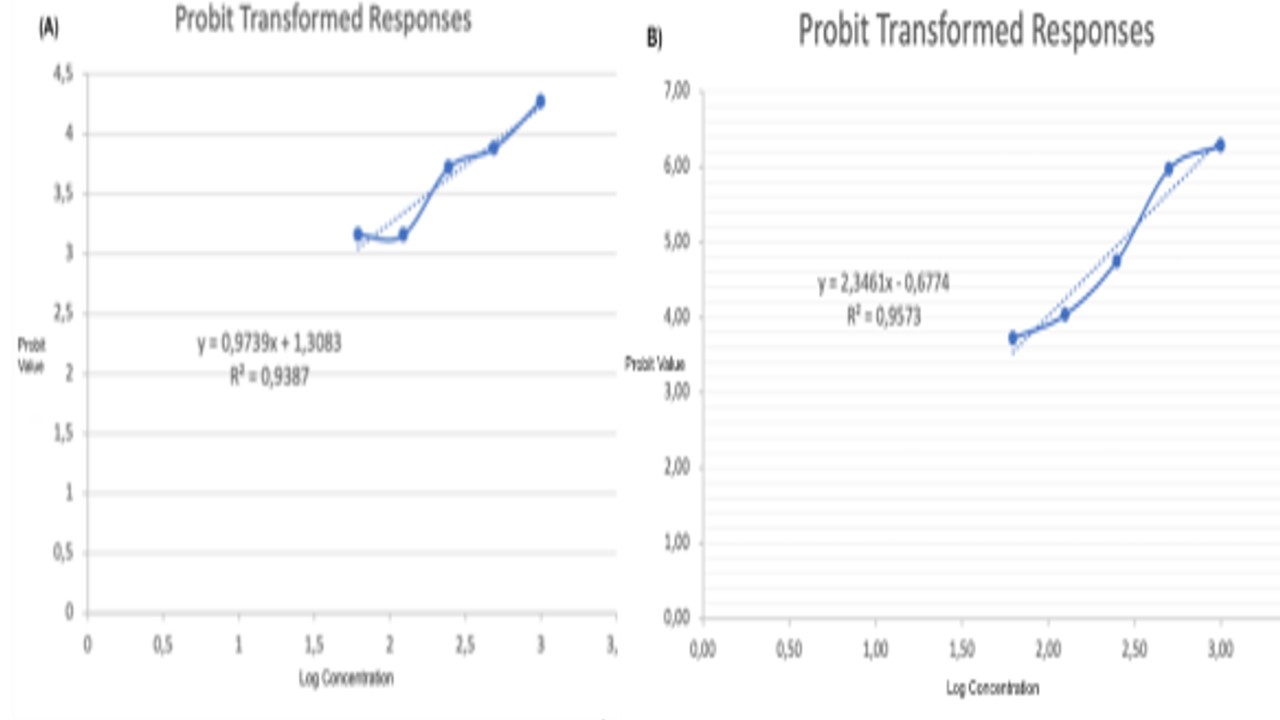
Curry leaves (Murraya koenigii) are used in traditional medicine; however, their toxicity and anticancer properties remain largely unexplored. This study assessed the toxicity of ethanol and decoction extracts of curry leaves using a Brine Shrimp Lethality Test (BSLT). Curry leaves were collected, dried, and extracted with 96% ethanol using the decoction method. Artemia salina larvae were exposed to extract concentrations (62.5, 125, 250, 500, and 1000 ppm) for 24 h. The lethal concentration 50 (LC50) values were determined by probit analysis. The ethanol extract showed toxicity with an LC50 of 263 ppm, whereas the decoction extract was non-toxic with an LC50 of 6,174 ppm. The ethanol extract had a higher mortality rate (93.3%) than the decoction extract (26.6%). The differential toxicity was due to the solvents and extraction techniques used. Ethanol extracts bioactive compounds, including toxic elements. The high temperature in the decoction process may break down heat-sensitive toxic compounds. This study concluded that the ethanol extract of curry leaves exhibited a more potent toxic effect than the decoction extract, warranting further research to identify toxic compounds with anticancer properties.
Abubakar, A.R., Haque, M., 2020. Preparation of medicinal plants: Basic extraction and fractionation procedures for experimental purposes. Journal of Pharmacy and Bioallied Sciences 12, 1–10.
Anwar, F., Saleem, U., Rehman, A.-U., Ahmad, B., Froeyen, M., Mirza, M.U., Kee, L.Y., Abdullah, I., Ahmad, S., 2021. Toxicity evaluation of the naphthalen-2-yl 3, 5-dinitrobenzoate: A drug candidate for alzheimer disease. Frontiers in Pharmacology 12, 607026–607026.
Bitwell, C., Indra, S.S., Luke, C., Kakoma, M.K., 2023. A review of modern and conventional extraction techniques and their applications for extracting phytochemicals from plants. Scientific African 19, e01585–e01585.
Bommakanti, V., Puthenparambil Ajikumar, A., Sivi, C.M., Prakash, G., Mundanat, A.S., Ahmad, F., Haque, S., Prieto, M.A., Rana, S.S., 2023. An overview of herbal nutraceuticals, their extraction, formulation, therapeutic effects and potential toxicity. Separations 10, 177–177.
Daniel, D., Maygusten, M., Gunawan, R., Magdaleni, A.R., 2023. Antioxidant Activity and Toxicity Tests of Panahan Leaf Extract (Ayapana triplinervis (Vahl) RM) against Shrimp Larvae (Artemia salina Leach). Journal of Carbazon 2, 37–45.
Fauziah, F., Harnelly, E., Ismail, Y.S., Fitri, L., 2022. Toxicity test of rose periwinkle (Catharanthus roseus) leaves endophytic bacteria using Brine Shrimp Lethality Test (BSLT) method. Biodiversitas: Journal of Biological Diversity 23.
Firnanda, F., Herupradoto, E. B. A., Rahmawati, K., Kurnijasanti, R., Sukmanadi, M., & Hidajati, N. , 2021. Toxicity testing of white pomegranate (Punica granatum L.) fruit extracts using Brine Shrimp Lethality Test method as a candidate of anti-cancer drug. Journal of Basic Medical Veterinary, 10(2), 45–50.
Franyoto, Y.D., Nurrochmad, A., Fakhrudin, N., 2024. Murraya koenigii L. Spreng.: An updated review of chemical composition, pharmacological effects, and toxicity studies. Journal of Applied Pharmaceutical Science 14.
Hanafi, H., Irawan, C., Sirait, S.M., Sulistiawaty, L., Setyawati, S.R., 2020. Toxicity Test with BSLT (Brine Shrimp Lethality Test) Method on Methanol, Ethyl Acetate Extract, Hexane on Seeds and Rind of Matoa extract (Pometia pinnata). Oriental Journal Of Chemistry 36, 1143–1147.
Kejariwal, M., 2020. Antioxidant potential of Murraya koenigii‘s (L.) Sprenge polysaccharides. Bull. Env. Pharmacol. Life Sci 10, 98–105.
Konan, A.M.L., Golly, K.J., Kra, A.K.M., Adima, A.A., Lohoues, E.E.C., 2022. Phytochemical Screening and Toxicity Assessment of Imperata cylindrica (L.) P. Beauv. (Poaceae) Raw Extracts with Brine Shrimp Lethality Assay. Journal of Biosciences and Medicines 10, 153–171.
Libralato, G., Prato, E., Migliore, L., Cicero, A., 2016. A review of toxicity testing protocols and endpoints with Artemia spp. Ecolological Indicator 69, 35–49.
Lu, Y., Yu, J., 2019. A Well-Established Method for the Rapid Assessment of Toxicity Using Artemia spp. Model. In: El-Din Saleh, H. (Ed.), Assessment and Management of Radioactive and Electronic Wastes. IntechOpen, London, pp. 1–15.
McCarty, L.S., Borgert, C.J., Burgoon, L.D., 2020. Evaluation of the inherent toxicity concept in environmental toxicology and risk assessment. Environmental Toxicology and Chemistry 39, 2351–2360.
Mensah, M.L., Komlaga, G., Forkuo, A.D., Firempong, C., Anning, A.K., Dickson, R.A., 2019. Toxicity and safety implications of herbal medicines used in Africa. Herbal medicine 63, 1849–1992.
Meyer, B.N., Ferrigni, N.R., Putnam, J.E., Jacobsen, L.B., Nichols, D., McLaughlin, J., 1982. Brine Shrimp: A Convenient General Bioassay for Active Plant Constituents. Planta medica 45, 31–34.
Nandy, S., Das, S., 2023. Unveiling the diverse medicinal properties of Murraya koenigii. Sciences of Phytochemistry 2, 107–126.
Pitakpawasutthi, Y., Suwatronnakorn, M., Issaravanich, S., Palanuvej, C., Ruangrungsi, N., 2021. In vitro cytotoxic, genotoxic, and antityrosinase activities of Clitoria macrophylla root. Journal of Advanced Pharmaceutical Technology & Research 12, 8–13.
Plaskova, A., Mlcek, J., 2023. New insights of the application of water or ethanol-water plant extract rich in active compounds in food. Frontiers in Nutrition 10, 1118761–1118761.
Rasyid, M.I., Yuliani, H., Triandita, N., Angraeni, L., Anggriawin, M., 2022. Toxicity Test of Laban Fruits (Vitex pinnata Linn) by Using Brine Shrimp Lethality Test (BSLT) Methode. Presented at the IOP Conference Series: Earth and Environmental Science, IOP Publishing, pp. 012051–012051.
Sablania, V., Bosco, S.J.D., Bashir, M., 2019. Extraction process optimization of Murraya koenigii leaf extracts and antioxidant properties. Journal of food science and technology 56, 5500–5508.
Satya, N.A., Pradana, D.L.C., Kolib, A., Aprilia, C.A., 2021. Brine shrimp lethality test on aqueous extract of Caesalpinia Sappan L. JFIOnline| Print ISSN 1412-1107| e-ISSN 2355-696X 13, 62–67.
Surbakti, C., Nasution, L.R., Rudang, S.N., Cintya, H., Vany, I., Agnes, P.A.T., Elsa, S.E.S., 2023. Toxicity Test of Ethanol Extract of Gagatan Harimau Leaves (Vitis Gracilis BL.) on Artemia Salina Leach Larvae Using Brine Shrimp Lethal Test (BSLT) Method. International Journal of Science, Technology & Management 4, 1501–1505.
Tabashiri, A., Qadirifard, M.S., Ghaderi, A., Rahmannia, M., Kiani, S., Sharafi, A., Nikzad, F., Ansari, A., Soveyzi, F., Deravi, N., 2022. A decade anti-diabetic potential of murraya koenigii (curry leaf): A narrative review. African Journal of Diabetes Medicine 30.
Wang, Y.-K., Li, W.Q., Xia, S., Guo, L., Miao, Y., Zhang, B.-K., 2021. Metabolic activation of the toxic natural products from herbal and dietary supplements leading to toxicities. Frontiers in pharmacology 12, 758468–758468.
Yaşar, M., Şenoğul, O., Karadeniz, B., Gök, A., Yoldaş, P.A., Ağan, K., 2020. Evaluation of acute and subacute toxicity of ISY-CP® food herbal mixture in rats. International Journal of Traditional and Complementary Medicine Research 1, 54–60.
Copyright (c) 2025 Fauzul Husna, Zulkarnain Zulkarnain, Ghina Nasywa

This work is licensed under a Creative Commons Attribution-ShareAlike 4.0 International License.
Journal of Basic Medical Veterinary (JBMV) by Unair is licensed under a Creative Commons Attribution-ShareAlike 4.0 International License.
1. The journal allows the author to hold the copyright of the article without restrictions.
2. The journal allows the author(s) to retain publishing rights without restrictions
3. The legal formal aspect of journal publication accessibility refers to Creative Commons Attribution Share-Alike (CC BY-SA).
4. The Creative Commons Attribution Share-Alike (CC BY-SA) license allows re-distribution and re-use of a licensed work on the conditions that the creator is appropriately credited and that any derivative work is made available under "the same, similar or a compatible license”. Other than the conditions mentioned above, the editorial board is not responsible for copyright violation.


 Perhimpunan Dokter Hewan Indonesia