Identification, Prevalence Estimation, and Mapping of Coccidiosis in Broiler Chickens (Gallus domesticus) Across Varying Elevations in Malang Regency and Batu City

Downloads
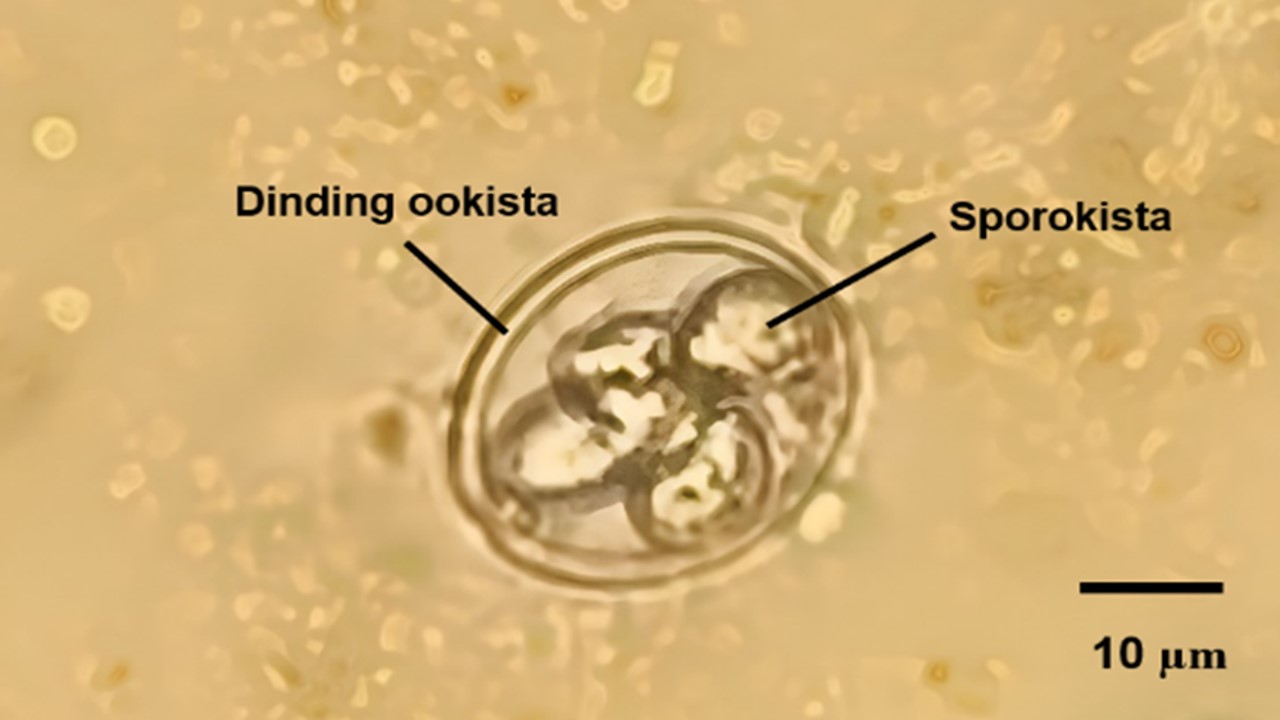
Broiler chickens are chickens that have been specifically bred for high meat production. The increase in chicken meat consumption has become both an opportunity and a challenge for farmers, one of which is coccidiosis. Coccidiosis is caused by the Eimeria protozoa, which commonly infect chickens and target their digestive tract. This study aims to calculate the proportion and identify Eimeria species that often cause coccidiosis in broiler chickens in Malang Regency and Batu City. A total of 180 fecal samples from 6 different farms were used. The examination was conducted using the McMaster method and sporulation for 2-7 days on positive samples by immersing feces in a 2% potassium dichromate solution. Identification of Eimeria species was based on morphology and morphometry and was then were analyzed using descriptive statistics. The relationship between risk factors and coccidiosis occurrence was analyzed using Chi-square. The distribution of coccidiosis infections in Malang was depicted on an epidemiological map. The results showed that there were 4 Eimeria species infecting the six subdistricts in Malang Regency and Batu City, namely E. necatrix, E. acervulina, E. praecox, and E. maxima. The proportion of coccidiosis incidence in Malang Regency and Batu City was 18.89%. The highest proportion was in Dau District (43.33%), followed by Pagelaran District (36.67%), Kromengan District (23.33%), Wagir District (6.67%), Junrejo District (3.33%), and lastly Batu District (0%). Chi-square analysis showed that altitude and temperature had a significant effect (p<0.05) on the coccidiosis incidence rate in Malang Regency and Batu City.
Adeyemi, O., Idowu, E., Akinsanya, B., & Jatau, I. 2023. Knowledge, Attitude, and Practices of Poultry Farmers Regarding the Control of Chicken Coccidiosis in Lagos State, Nigeria. Pan African Journal of Life Sciences 7(1): 611-621.
Agustin, A. L. D., & Ningtyas, N. S. I. 2020. Prevalensi Koksidiosis pada Ayam Broiler di Kecamatan Narmada Nusa Tenggara Barat [Prevalence of Coccidiosis in Broiler Chickens in Narmada District, West Nusa Tenggara]. Jurnal Sangkareang Mataram 6: 48–50.
Alsayeqh, A., & Abbas, R. 2023. Nutritional Supplements for the Control of Avian Coccidiosis – A Review. Annals of Animal Science 23(4): 993-1007.
Ashenafi, H., Tadesse, S., & Medhin, G. 2004. Study on Coccidiosis of Scavenging Indigenous Chickens in Central Ethiopia. Tropical Animal Health and Production 36: 693–701.
Attia, Y., Bovera, F., Wang, J., Al-Harthi, M., & Kim, W. 2020. Multiple Amino-Acid Supplementations to Low-Protein Diets: Effect on Performance, Carcass Yield, Meat Quality and Nitrogen Excretion of Finishing Broilers Under Hot Climate Conditions. Animals 10(6): 973.
Attree, E., Sanchez-Arsuaga, G., Jones, M., Xia, D., Marugan-Hernandez, V., Blake, D. and Tomley, F., 2021. Controlling the causative agents of coccidiosis in domestic chickens; an eye on the past and considerations for the future. CABI Agriculture and Bioscience, 2(1), p.37.
Bafundo, K., Duerr, I., McNaughton, J., & Johnson, A. 2021. Effects of a Quillaja and Yucca Combination on Performance and Carcass Traits of Coccidia-Vaccinated Broilers Exposed to an Enteric Disease Challenge. Poultry Science 100(10): 101391.
Begum, N., Shams, S., Badshah, F., Khattak, I., Khan, M.S., Khan, N.U., Naz, W., Ibáñez-Arancibia, E., De los Ríos-Escalante, P.R., Hassan, S. and Said, M.B., 2024. Prevalence and determination of species distribution of Eimeria in poultry from the Swabi district, Pakistan. Veterinary World, 17(9), p.1983.
Blake, D., Worthing, K., & Jenkins, M. 2020. Exploring Eimeria Genomes to Understand Population Biology: Recent Progress and Future Opportunities. Genes 11(9): 1103.
Blake, D.P. & Tomley, F.M. 2014. Securing Poultry Production from the Ever-Present Eimeria Challenge. Trends in Parasitology 30(1): 12-19.
Blake, D.P., Knox, J., Dehaeck, B., Huntington, B., Rathinam, T., Ravipati, V., Ayoade, S., Gilbert, W., Adebambo, A.O., Jatau, I.D., Raman, M., Parker, D., Rushton, J., & Tomley, F.M. 2020. Re-Calculating the Cost of Coccidiosis in Chickens. Veterinary Research 51(1): 115.
Blake, D.P., Knox, J., Dehaeck, B., Huntington, B., Rathinam, T., Ravipati, V., Ayoade, S., Gilbert, W., Adebambo, A.O., Jatau, I.D. and Raman, M., 2020. Re-calculating the cost of coccidiosis in chickens. Veterinary research, 51(1), p.115.
Borgonovo, F., Ferrante, V., Grilli, G., & Guarino, M. 2024. Innovative Approach for Analysing and Evaluating Enteric Diseases in Poultry Farms. Acta IMEKO 13(1): 1-5.
Borgonovo, F., Ferrante, V., Grilli, G., Pascuzzo, R., Vantini, S., & Guarino, M. 2020. A Data-Driven Prediction Method for Early Warning of Coccidiosis in Intensive Livestock Systems: A Preliminary Study. Animals 10(4): 747.
Caesario, B. G., Setiawan, E., & Primananda, R. 2023. Sistem Pengendalian Suhu pada Kandang Ayam Broiler menggunakan PID Controller [Temperature Control System in Broiler Chicken Coops using PID Controller]. Jurnal Pengembangan Teknologi Informasi dan Ilmu Komputer 7: 1336-1344.
Chapman, H.D., Barta, J.R., Blake, D., Gruber, A., Jenkins, M., Smith, N.C., Suo, X., & Tomley, F.M. 2013. A Selective Review of Advances in Coccidiosis Research. Advances in Parasitology 83: 93-171.
Chen, H.L., Zhao, X.Y., Zhao, G.X., Huang, H.B., Li, H.R., Shi, C.W., Yang, W.T., Jiang, Y.L., Wang, J.Z., Ye, L.P. and Zhao, Q., 2020. Dissection of the cecal microbial community in chickens after Eimeria tenella infection. Parasites & vectors, 13(1), p.56.
Conway, D. P., & McKenzie, M. E. 2007. Poultry Coccidiosis: Diagnostic and Testing Procedures, 1st ed. Wiley.
Correia, S., Suratma, N. A., & Oka, I. B. M. 2022. Prevalensi dan Intensitas Infeksi Eimeria spp. April-Mei 2021 pada Ayam Petelur Lebih Tinggi daripada Ayam Pedaging di Tembuku, Bangli, Bali [Prevalence and Intensity of Eimeria spp. Infection in April-May 2021 in Laying Hens Higher than in Broiler Chickens in Tembuku, Bangli, Bali]. IMV 11: 343–349.
Craig, A., Khattak, F., Hastie, P., Bedford, M., & Olukosi, O. 2020. Effect of Carbohydrase or Prebiotic Supplementation in Broilers Challenged with Coccidiosis. PLOS One 15(2): e0229281.
Ekawasti, F., & Martindah, E. 2019. Control of Coccidiosis in Chickens Through Herbal Medicine. WARTAZOA 29: 1.
Fatoba, A. J., & Adeleke, M. A. 2018. Diagnosis and Control of Chicken Coccidiosis: A Recent Update. J Parasit Dis 42: 483–493.
Fatoba, A.J. & Adeleke, M.A. 2018. Diagnosis and Control of Chicken Coccidiosis: A Recent Update. Journal of Parasitic Diseases 42(4): 483-493.
Flores, R.A., Nguyen, B.T., Cammayo, P.L.T., Võ, T.C., Naw, H., Kim, S., Kim, W.H., Na, B.K. and Min, W., 2022. Epidemiological investigation and drug resistance of Eimeria species in Korean chicken farms. BMC Veterinary Research, 18(1), p.277.
Gebretensae, H., Gebreyohannes, M., & Tesfaye, A. 2014. Prevalence of Poultry Coccidiosis in Gondar Town, North West Ethiopia. American-Eurasian Journal of Scientific Research 9: 129-135.
Ghareeb, A. F. A., Schneiders, G. H., Foutz, J. C., Milfort, M. C., Fuller, A. L., Yuan, J., Rekaya, R., & Aggrey, S. E. 2022. Heat Stress Alters the Effect of Eimeria maxima Infection on Ileal Amino Acids Digestibility and Transporters Expression in Meat-Type Chickens. Animals 12: 1554.
Ghareeb, A.F.A., Foutz, J.C., Schneiders, G.H., Richter, J.N., Milfort, M.C., Fuller, A.L., Rekaya, R., & Aggrey, S.E. 2022. Heat Stress Modulates the Disruptive Effects of Eimeria maxima Infection on the Ileum Nutrient Digestibility, Molecular Transporters, and Tissue Morphology in Meat-Type Chickens. PLoS One 17(6): e0269131.
Gharekhani, J., Sadeghi-Dehkordi, Z., & Bahrami, M. 2014. Prevalence of Coccidiosis in Broiler Chicken Farms in Western Iran. Journal of Veterinary Medicine: 1-4.
Gumina, E., Hall, J.W., Vecchi, B., Hernandez-Velasco, X., Lumpkins, B., Mathis, G. and Layton, S., 2021. Evaluation of a subunit vaccine candidate (Biotech Vac Cox) against Eimeria spp. in broiler chickens. Poultry Science, 100(9), p.101329.
Gyorke, A., Pop, L., & Cozma, V. 2013. Prevalence and Distribution of Eimeria Species in Broiler Chicken Farms of Different Capacities. Parasite 20: 50.
Harahap, M., Sulardiono, B., & Suprapto, D. 2018. Analisis Tingkat Kematangan Gonad Teripang Keling (Holothuria atra) Di Perairan Menjangan Kecil, Karimunjawa [Analysis Of Gonad Maturation Level Of Black Sea Cucumber (Holothuria atra) In Menjangan Kecil Waters, Karimunjawa]. Manage. Aqua. Resourc.J 7: 263–269.
Hartono, M., Santosa, P. E., Ermawati, R., & Sirat, M. M. P. 2020. Tingkat Infestasi Koksidiosis (Eimeria sp.) pada Kerbau Lumpur (Bubalus bubalis Linn.) di Kecamatan Jati Agung Kabupaten Lampung Selatan [Infestation Rate of Coccidiosis (Eimeria sp.) in Swamp Buffalo (Bubalus bubalis Linn.) in Jati Agung District, South Lampung Regency]. Prosiding Seminar Nasional Teknologi Peternakan dan Veteriner Virtual.
Jadhav, B. 2024. Current Status of Poultry Coccidiosis in Developing India. Asian Journal of Research in Zoology 7(1): 1-5.
Justan, R., Margiono, Aziz, A., & Sumiati. 2024. Penelitian Kombinasi (Mixed Methods) [Combined Research (Mixed Methods)]. ULIL ALBAB: Jurnal Ilmiah Multidisiplin 3: 253-263.
Kpomasse, C., Oke, O., Houndonougbo, F., & Tona, K. 2021. Broiler Production Challenges in the Tropics: A Review. Veterinary Medicine and Science 7(3): 831-842.
Kumar, S., Chen, C., Indugu, N., Werlang, G.O., Singh, M., Kim, W.K., & Thippareddi, H. 2019. Oxidative Stress in the Poultry Gut: Potential Challenges and Interventions. Frontiers in Veterinary Science 6: 60.
Lawal, J. R., Jajere, S. M., Ibrahim, U. I., Geidam, Y. A., Gulani, I. A., Musa, G., & Ibekwe, B. U. 2016. Prevalence of Coccidiosis Among Village and Exotic Breed of Chickens in Maiduguri, Nigeria. Veterinary World 9: 653-659.
Lee, Y., Lu, M., & Lillehoj, H. 2022. Coccidiosis: Progress in Host Immunity and Alternatives to Antibiotics. Vaccines 10(2): 215.
Liao, S., Lin, X., Zhou, Q., Wang, Z., Yan, Z., Wang, D., Su, G., Li, J., Lv, M., Hu, J., Cai, H., Song, Y., Chen, X., Zhu, Y., Yin, L., Zhang, J., Qi, N., & Sun, M. 2024. Epidemiological Investigation of Coccidiosis and Associated Risk Factors in Broiler Chickens Immunized with Live Anticoccidial Vaccines in China. Front. Vet. Sci. 11: 1375026.
Liu, G., Ajao, A.M., Shanmugasundaram, R., Taylor, J., Ball, E., Applegate, T.J., Selvaraj, R., Kyriazakis, I., Olukosi, O.A. and Kim, W.K., 2023. The effects of arginine and branched-chain amino acid supplementation to reduced-protein diet on intestinal health, cecal short-chain fatty acid profiles, and immune response in broiler chickens challenged with Eimeria spp. Poultry Science, 102(7), p.102773.
Mahmoud, W., Mahmoud, E., Soliman, M., & Abd El Hafez, M. 2023. Evaluation of the Efficacy of Vaccine in Coccidiosis in Broilers in New Valley Governorate. New Valley Veterinary Journal 3: 8-15.
Munoz-Gomes, V., Furrer, R., Yin, J., Shaw, A. P. M., Rasmussen, P., & Torgerson, P. R. 2024. Prediction of Coccidiosis Prevalence in Extensive Backyard Chickens in Countries and Regions of the Horn of Africa. Veterinary Parasitology 327.
Ngom, R.V., Ayissi, G.J., Akoussa, A.M., Laconi, A., Jajere, S.M., Zangue, H.A. and Piccirillo, A., 2024. A Systematic Review and Meta‐Analysis of the Efficacy of Biosecurity in Disease Prevention and Control in Livestock Farms in Africa. Transboundary and Emerging Diseases, 2024(1), p.8683715.
Nguyen, B.T., Yim, D., Flores, R.A., Lee, S.Y., Kim, W.H., Jung, S.H., Kim, S. and Min, W., 2024. Large-scale field trials of an Eimeria vaccine induce positive effects on the production index of broilers. Vaccines, 12(7), p.800.Nguyen. 2024. Spore Measurements Using ImageJ v1.
Nurnasari, E., & Djumali. 2016. Pengaruh Kondisi Ketinggian Tempat Terhadap Produksi dan Mutu Tembakau Temanggung [The Influence of Altitude Conditions on the Production and Quality of Temanggung Tobacco]. Bul. Tan. Tembakau, Serat & Minyak Industri 2: 45.
Oke, O.E., Akosile, O.A., Uyanga, V.A., Oke, F.O., Oni, A.I., Tona, K. and Onagbesan, O.M., 2024. Climate change and broiler production. Veterinary Medicine and Science, 10(3), p.e1416.
Pradana, D. P., Haryono, T., & Ambarwati, R. 2015. Identifikasi Cacing Endoparasit pada Feses Ayam Pedaging dan Ayam Petelur [Identification of Endoparasitic Worms in Feces of Broiler and Laying Hens]. LenteraBio 4: 119-123.
Qaid, M.M., Al-Mufarrej, S.I., Azzam, M.M., Al-Garadi, M.A., Albaadani, H.H., Alhidary, I.A. and Aljumaah, R.S., 2021. Anti-coccidial effect of rumex nervosus leaf powder on broiler chickens infected with Eimeria tenella oocyst. Animals, 11(1), p.167.
Qiao, Y., Feng, Q., Wang, Q., Zhao, Q., Zhu, S., Zhao, F., Wang, Z., Zhang, R., Wang, J., Yu, Y. and Han, H., 2024. Alteration in the gut microbiota of chickens resistant to Eimeria tenella Infection. Microorganisms, 12(11), p.2218.
Quiroz-Castañeda, R.E. & Dantán-González, E. 2015. Control of Avian Coccidiosis: Future and Present Natural Alternatives. BioMed Research International 2015: 430610.
Ramalingam, V., Raman, M., Bohra, K., Azhahianambi, P., & Raj, G. 2023. Cloning, Expression and Purification of Eimeria maxima EmGam56 Antigen. Journal of Parasitic Diseases 47(4): 773-777.
Ranganathan, P., Aggarwal, R., & Pramesh, C. 2015. Common Pitfalls in Statistical Analysis: Odds Versus Risk. Perspect Clin Res 6: 222.
Rehman, Z. U., Chand, N., & Khan, R. U. 2017. The Effect of Vitamin E, L-Carnitine, and Ginger on Production Traits, Immune Response, and Antioxidant Status in Two Broiler Strains Exposed to Chronic Heat Stress. Environ Sci Pollut Res 24: 26851–26857.
Répérant, J., Thomas-Hénaff, M., Benoit, C., Bihannic, P., & Eterradossi, N. 2021. Impact of Maturity on Sporulation Ability of Eimeria Oocysts. Parasite 28: 32.
Schneiders, G. H., Fotz, J. C., Fuller, A. L., Nelson, J., Rekaya, R., & Aggrey, S. E. 2020. The Effect of Increased Temperatures on Viability, Morphology, Infectivity, and Development of Eimeria tenella. Journal of Parasitology 106: 428-437.
Schneiders, G.H., Foutz, J.C., Milfort, M.C., Ghareeb, A.F., Fuller, A.L., Rekaya, R., Williams, S.M. and Aggrey, S.E., 2020. Heat stress reduces sexual development and affects pathogenesis of Eimeria maxima in meat-type chickens. Scientific Reports, 10(1), p.10736.
Sharma, M., & Kim, W. 2024. Coccidiosis in Egg-Laying Hens and Nutritional Strategies to Modulate Performance and Immunity. Animals 14(7): 1015.
Silva, J. T. D., Alvares, F. B. V., Lima, E. F. D., Silva Filho, G. M. D., Silva, A. L. P. D., Lima, B. A., Feitosa, T. F., & Vilela, V. L. R. 2022. Prevalence and Diversity of Eimeria spp. in Free-Range Chickens in Northeastern Brazil. Front. Vet. Sci. 9.
Sokale, A., Williams, C., Hoerr, F., Collins, K., & Peebles, E. 2021. Embryonic Age at In-Ovo Vaccination Alters Vaccine Cycling and Broiler Performance. Poultry Science 100(3): 100914.
Soutter, F., Werling, D., Tomley, F., & Blake, D. 2020. Poultry Coccidiosis: Design and Interpretation of Vaccine Studies. Frontiers in Veterinary Science 7: 101.
Taylor, J., Walk, C., Misiura, M., Sorbara, J., Giannenas, I., & Kyriazakis, I. 2022. Quantifying the Effect of Coccidiosis on Broiler Performance. Poultry Science 101(4): 101746.
Terfa, W., Kumsa, B., Ayana, D., Maurizio, A., Tessarin, C., & Cassini, R. 2023. Epidemiology of Gastrointestinal Parasites of Cattle in Three Districts in Central Ethiopia. Animals 13.
Williams, R.B. 1999. A Compartmentalised Model for the Estimation of the Cost of Coccidiosis to the World's Chicken Production Industry. International Journal for Parasitology 29(8): 1209-1229.
Wondimu, A., Mesfin, E., & Bayu, Y. 2019. Prevalence of Poultry Coccidiosis and Associated Risk Factors in Intensive Farming System of Gondar Town, Ethiopia. Veterinary Medicine International 2019: 1–6.
Yesica, R., Kusumarini, S., & Wisesa, I. 2021. Prevalence, Identification and Geographical Distribution of Eimeria spp. in Wild Rodents in Malang, East Java. Acta Vet Indones 78–85.
Yu, M., & Heo, J. 2021. Comprehensive Overview of Coccidiosis in Chickens. Animal Industry and Technology 8(2): 53-63.
Yunianto, B., & V.D. 2017. Fisiologi Pertumbuhan Pada Ayam Broiler Akibat Perubahan Temperatur Lingkungan [Growth Physiology in Broiler Chickens Due to Environmental Temperature Changes]. Jurnal Litbang Provinsi Jawa Tengah 15: 183–188.
Zefanya, F., Apsari, I. A. P., & Oka, I. B. M. 2021. Prevalence and Identification of Eimeria Sp., and Isospora Sp., an Intestinal Protozoa of Bali Cattle in Wet Highlands and Lowlands. IMV 10: 180–188.
Zhou, X., Wang, L., Zhu, P., Yang, Z., Wang, Z., Chen, Y., Gu, X., He, R., Xu, J., Jing, B. and Yang, G., 2023. Comprehensive molecular characterization of complete mitogenome assemblies of 33 Eimeria isolates infecting domestic chickens. Parasites & vectors, 16(1), p.109.
Copyright (c) 2025 Heri Irawan, Filza Hannani Vawzia Hanifa, Shelly Kusumarini R, Habib Syaiful Arif Tuska, Reza Yesica

This work is licensed under a Creative Commons Attribution-ShareAlike 4.0 International License.
Journal of Basic Medical Veterinary (JBMV) by Unair is licensed under a Creative Commons Attribution-ShareAlike 4.0 International License.
1. The journal allows the author to hold the copyright of the article without restrictions.
2. The journal allows the author(s) to retain publishing rights without restrictions
3. The legal formal aspect of journal publication accessibility refers to Creative Commons Attribution Share-Alike (CC BY-SA).
4. The Creative Commons Attribution Share-Alike (CC BY-SA) license allows re-distribution and re-use of a licensed work on the conditions that the creator is appropriately credited and that any derivative work is made available under "the same, similar or a compatible license”. Other than the conditions mentioned above, the editorial board is not responsible for copyright violation.



 Perhimpunan Dokter Hewan Indonesia