Bioactivity-Guided Evaluation of Tabernaemontana divaricata Leaf Fractions Reveals Promising Anti-Inflammatory, Antipyretic, and Analgesic Effects in Mice

Downloads
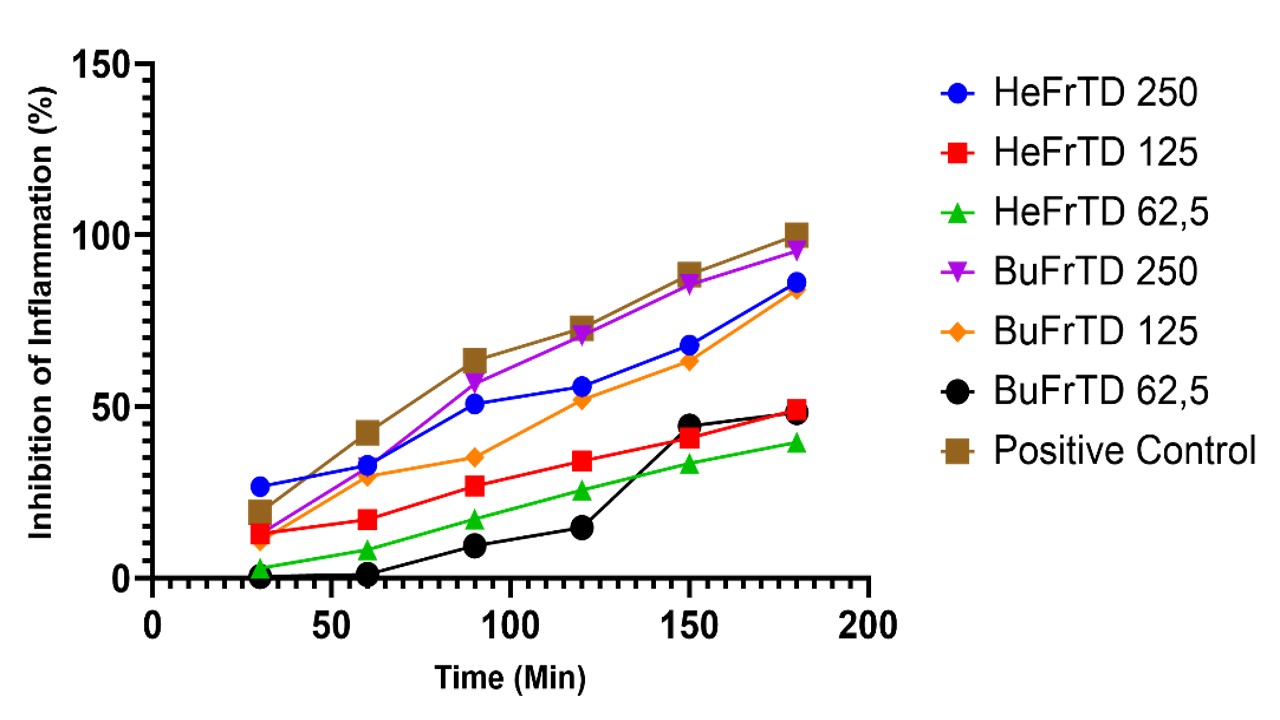
Inflammation, pain, and fever are major physiological responses to tissue injury or infection that often require pharmacological intervention. However, prolonged use of non-steroidal anti-inflammatory drugs (NSAIDs) may cause gastrointestinal and hepatic toxicity, encouraging the search for safer natural alternatives. Tabernaemontana divaricata has been traditionally used to treat inflammatory and febrile conditions, yet limited studies have evaluated the pharmacological properties of its solvent fractions. This study aimed to assess the anti-inflammatory, antipyretic, and analgesic activities of the hexane (HeFrTD) and butanol (BuFrTD) fractions derived from the ethyl acetate extract of T. divaricata leaves in male mice. The fractions were obtained through liquid–liquid partitioning and administered orally at doses of 62.5, 125, and 250 mg/kg body weight. Anti-inflammatory, antipyretic, and analgesic effects were evaluated using carrageenan-induced paw edema, peptone-induced pyrexia, and hot plate assays, respectively. Statistical analysis was conducted using one-way ANOVA followed by Bonferroni’s post hoc test. Both fractions significantly (p < 0.05) reduced inflammation, pyrexia, and pain in a dose-dependent manner. The 250 mg/kg dose produced strong anti-inflammatory and antipyretic responses, with no statistically significant difference from diclofenac and paracetamol within the experimental model. Analgesic activity suggested possible involvement of central pathways commonly associated with opioid receptor modulation. In conclusion, the fractions of T. divaricata exhibit notable multi-target pharmacological effects, supporting their traditional use and potential for development as natural anti-inflammatory, antipyretic, and analgesic agents.
Afsar, T., Khan, M.R., Razak, S., Ullah, S., Mirza, B., 2015. Antipyretic, anti-inflammatory and analgesic activity of Acacia hydaspica R. Parker and its phytochemical analysis. BMC Complementary and Alternative Medicine 15, 136.
Ali Khan, M.S., Misbah, Ahmed, N., Arifuddin, M., Rehman, A., Ling, M.P., 2018. Indole alkaloids and anti-nociceptive mechanisms of Tabernaemontana divaricata (L.) R. Br. flower methanolic extract. Food and Chemical Toxicology 118, 953–962.
Alim, N., Hasanuddin, R., Jasmiadi, J., Musdalifah, M., Hagg, A.I., Linda, N., 2023. Antipyretic Activity of Ethanol Extract from Beligo (Benincasa hispida (Thunb.) Cogn.) Fruit Flesh in Wistar Albino Rats (Rattus norvegicus). Jurnal Ilmiah Sains 89–98.
Anbukkarasi, M., Sundararajan, M., Venkadeswaran, K., Ruban, V.V., Anand, T., Geraldine, P., 2019. Antihypercholesterolemic, antioxidative and anti-inflammatory potential of an extract of the plant Tabernaemontana divaricata in experimental rats fed an atherogenic diet. Biocatalysis and Agricultural Biotechnology 19, 101115.
Ayoub, S.S., 2021. Paracetamol (acetaminophen): A familiar drug with an unexplained mechanism of action. Temperature (Austin) 8, 351–371.
Bintarti, T., 2010. Uji Efek Anti Inflamasi dan Analgetik Ekstrak Daun Mondokaki (Tabernaemontana divaricata R.Br) Secara Oral dan Topikal terhadap Mencit (Thesis). Universitas Sumatera Utara, Medan.
Bouyahya, A., Guaouguaou, F.-E., El Omari, N., El Menyiy, N., Balahbib, A., El-Shazly, M., Bakri, Y., 2022. Anti-inflammatory and analgesic properties of Moroccan medicinal plants: Phytochemistry, in vitro and in vivo investigations, mechanism insights, clinical evidences and perspectives. J Pharm Anal 12, 35–57.
Chagas, M. do S.S., Behrens, M.D., Moragas-Tellis, C.J., Penedo, G.X.M., Silva, A.R., Gonçalves-de-Albuquerque, C.F., 2022. Flavonols and Flavones as Potential anti-Inflammatory, Antioxidant, and Antibacterial Compounds. Oxidative Medicine and Cellular Longevity 2022, 9966750.
Chouikh, A., Ben Ali, A., Bousbia Brahim, A., 2024. Exploring Therapeutic Potential of Malcolmia Aegyptiaca Spr. and Matthiola Livida DC. Extracts in Rat Models Using Hot-Plate, Writhing and Carrageenan-Induced Paw Edema Tests. Acta Medica Bulgarica 51, 102–109.
Deng, Y., Bao, M.-F., Shi, B.-B., Wu, J., Cai, X.-H., 2018. Three New Indole Alkaloids from Tabernaemontana divaricata. Nat. Prod. Bioprospect. 8, 183–188.
Devi, P., Singh, U.P., Kumar, A., 2024. Phytochemistry, Pharmacognosy and Pharmacological Properties of Tabernaemontana divaricata: A Review. IJPSM 9, 119–125.
Fadhli, H., Fadhila, Q.N., Djohari, M., Ulfa, R., 2023. Review Artikel: Tumbuhan Obat Mondokaki (Tabernaemontana divaricata (L). R.Br). Farmaka 21, 429–436.
Fadlilaturrahmah, F., Putra, A.M.P., Rizki, M.I., Nor, T., 2021. Uji Aktivitas Antioksidan dan Antitirosinase Fraksi n-Butanol Daun Sungkai (Peronema canescens Jack.) Secara Kualitatif Menggunakan Kromatografi Lapis Tipis. JPS 8, 90.
Gentry, C., Andersson, D.A., Bevan, S., 2015. TRPA1 mediates the hypothermic action of acetaminophen. Sci Rep 5, 12771.
Ghosh, P., Poddar, S., Chatterjee, S., 2021. Morphological features, phytochemical and ethnopharmacological attributes of Tabernaemontana divaricata Linn.: A comprehensive review. J Pharmacogn Phytochem 10, 31–36.
Herdaningsih, S., Oktaviyeni, F., Utari, I., 2019. Aktivitas Antipiretik Ekstrak Etanol Daun Mengkudu (Morinda citrifolia L.) Terhadap Tikus Putih Jantan (Rattus norvegicus) Galur Wistar Yang Diinduksi Pepton 5%. Medical Sains : Jurnal Ilmiah Kefarmasian 3, 75–82.
Hossain, H., Al-Mansur, A., Akter, S., Sara, U., Ahmed, M.R., Jahangir, A.A., 2014. Evaluation of anti-inflammatory activity and total tannin content from the leaves of Bacopa monnieri (Linn.). International Journal of Pharmaceutical Sciences and Research 5, 1246.
Iqbal, A., Khan, A.U., Khan, M., Khattak, A., Amin, M.U., Zubair, M., Zeb, A., Bibi, N., Ali, Q., Han, S., Ali, D., 2025. Comprehensive Computational and In Vivo Approaches to Assess the Analgesic Activity of the Selected Flavonoids from the Maclura Plant Against the Mu-Opioid Receptor. ChemistrySelect 10, e01592.
Irinmwinuwa, E.O., Unekwe, P.C., Egba, E.U., Metu, E.C., Cherech, N.C., 2022. Acetaminophen: Ancient drug with a novel analgesic mechanism of action. World Journal of Advanced Research and Reviews 16, 580–589.
Ishola, I.O., Agbaje, E.O., Adeyemi, O.O., Shukla, R., 2014. Analgesic and anti-inflammatory effects of the methanol root extracts of some selected Nigerian medicinal plants. Pharmaceutical Biology 52, 1208–1216.
Jain, S., Sharma, P., Ghule, S., Jain, A., Jain, N., 2013. In vivo anti-inflammatory activity of Tabernaemontana divaricata leaf extract on male albino mice. Chin J Nat Med 11, 472–476.
Jin, X., Song, S., Wang, J., Zhang, Q., Qiu, F., Zhao, F., 2016. Tiliroside, the major component of Agrimonia pilosa Ledeb ethanol extract, inhibits MAPK/JNK/p38-mediated inflammation in lipopolysaccharide-activated RAW 264.7 macrophages. Experimental and Therapeutic Medicine 12, 499–505.
Kanthlal, S., Suresh, V., Arunachalam, G., Frank, P.R., Kameshwaran, S., 2011. In vivo Evaluation of Analgesic and Antipyretic activity of Aerial parts of Tabernaemontana divaricata in Experimental Animal models. Pharmacologyonline 3, 1127–1133.
Kustiawan, P.M., Dewi, S.R., Pratiwi, J., Aisyiyah, N.M., Nugraha, A.S.D., Setiawan, I.M., 2023. Phytochemical Analysis and Anti-Inflammatory Activity of The Combination of Trigona apicalis propolis Extract and Honey. Borneo Journal of Pharmacy 6, 125–132.
Lavich, T.R., Cordeiro, R.S.B., Silva, P.M.R., Martins, M.A., 2005. A novel hot-plate test sensitive to hyperalgesic stimuli and non-opioid analgesics. Braz J Med Biol Res 38, 445–451.
Li, X.-M., Jiang, X.-J., Wei, G.-Z., Ren, L.-H., Wang, L.-X., Cheng, X.-L., Wang, F., 2019. New Iboga-Type Indole Alkaloids from Tabernaemontana divaricata. Nat. Prod. Bioprospect. 9, 425–429.
Liu, J., Li, J., Li, Z., Dong, F., Guo, W., Ge, W., Patterson, T.A., Hong, H., 2025. Developing predictive models for µ opioid receptor binding using machine learning and deep learning techniques. Exp. Biol. Med. 250, 10359.
Magama, S., Asita, A.O., 2017. Evaluation of Chenopodium album Linn. Crude Methanolic Leaf Extract for Central Antinociceptive Activity in Albino Mice using the Hot Plate Test. International Journal of Sciences 6, 36–44.
Md Idris, M.H., Mohd Amin, Siti Norhidayu, Mohd Amin, Siti Norhidayah, Nyokat, N., Khong, H.Y., Selvaraj, M., Zakaria, Z.A., Shaameri, Z., Hamzah, A.S., Teh, L.K., Salleh, M.Z., 2022. Flavonoids as dual inhibitors of cyclooxygenase-2 (COX-2) and 5-lipoxygenase (5-LOX): molecular docking and in vitro studies. Beni-Suef University Journal of Basic and Applied Sciences 11, 117.
Mochtar, C.F., Aisyiyah, N.M., Husna, Q.A., Hamzah, H., Bakhtiar, M.I., Devi, R.S., Varizza, F.P., Faradillah, A., Hafidzah, E., Suriati, S., Damis, N.L., 2023a. Antipyretic And Antiinflammatory Activities Of Bopot Leaf Extract From Kutai Kartanegara District. Indonesian Journal of Pharmaceutical Science and Technology 80–89.
Mochtar, C.F., Devi, R.S., Hamzah, H., Faradillah, A., Hafidzah, E., Varizza, F.P., Aisyiyah, N.M., 2023b. In-Vivo Anti-Inflammatory Activity of Kelubut Leaf Ethyl Acetate Extract (Passiflora foetida L.) from Samarinda City. Journal of Fundamental and Applied Pharmaceutical Science 4, 15–22.
Mochtar, C.F., Hafidzah, E., Damis, N.L., Bakhtiar, M.I., Faradillah, A., Varizza, F.P., Aisyiyah, N.M., Devi, R.S., 2023c. Aktivitas Antidiare Secara In-Vivo Ekstrak Etil Asetat Daun Bopot (Tabernaemontana divaricata) Dari Kecamatan Tenggarong, Kabupaten Kutai Kartanegara Kalimantan Timur. HERBAPHARMA: Journal of Herb Farmacological 5, 60–67.
Mondal, S., Chakrabarty, K., Bose, M., Maity, S., Chowdhury, S.S., Das, S., Samanta, S., Saha, S., 2024. Exploring The Therapeutic Potential: In-Vitro Assessment of Antioxidant and Anti-Inflammatory Activity Of methanolic extract from Tabernaemontana divaricata Leaves. Journal of Survey in Fisheries Sciences 134–140.
Muhammad, N., Saeed, M., Khan, H., 2012. Antipyretic, analgesic and anti-inflammatory activity of Viola betonicifolia whole plant. BMC Complementary and Alternative Medicine 12, 59.
Naidoo, C.M., Naidoo, Y., Dewir, Y.H., Murthy, H.N., El-Hendawy, S., Al-Suhaibani, N., 2021. Major Bioactive Alkaloids and Biological Activities of Tabernaemontana Species (Apocynaceae). Plants 10, 313.
Peranginangin, J.M., 2009. Anti-Inflammatory Activity Test Of Mondokaki Leaves (Tabernaemontana divaricata, R.Br.) Ethnolic Extract On Male White Rat. Jurnal Farmasi Indonesia 6, 41–47.
Pratchayasakul, W., Pongchaidecha, A., Chattipakorn, N., Chattipakorn, S., 2008. Ethnobotany & ethnopharmacology of Tabernaemontana divaricata. Indian J Med Res 127, 317–335.
Rahmi, A., Afriani, T., Sari, L.P., Filmawati, 2021. Uji Aktivitas Antipiretik Ekstrak Etanol Daun Sembung (Blumea balsamifera) Secara In Vivo Terhadap Mencit Putih Jantan (Mus musculus). Majalah Farmasi dan Farmakologi 25, 7–10.
Ramalingam, S., Annapurani, 2020. Evaluation of in vitro and in vivo anti-inflammatory activity of flavonoid extract of Thespesia populnea and Tabernaemontana divaricata leaves in Swiss albino mice. Medicinal Plants - International Journal of Phytomedicines and Related Industries 12, 591–597.
Rezq, S., Mahmoud, M.F., El-Shazly, A.M., El Raey, M.A., Sobeh, M., 2021. Anti-Inflammatory, Antipyretic, and Analgesic Properties of Potamogeton perfoliatus Extract: In Vitro and In Vivo Study. Molecules 26, 4826.
Sembiring, E., Sangi, M.S., Suryanto, E., 2019. Aktivitas Antioksidan Ekstrak Dan Fraksi Dari Biji Jagung (Zea mays L.). CHEMISTRY PROGRESS 9.
Sharma, C.V., Long, J.H., Shah, S., Rahman, J., Perrett, D., Ayoub, S.S., Mehta, V., 2017. First evidence of the conversion of paracetamol to AM404 in human cerebrospinal fluid. J Pain Res 10, 2703–2709.
Sharma, V.C., Kaushik, A., Dey, Y.N., Srivastava, B., Wanjari, M., Jaiswal, B., 2020. Analgesic, anti-inflammatory and antipyretic activities of ethanolic extract of stem bark of Anogeissus latifolia Roxb. Clinical Phytoscience 6, 22.
Sluter, M.N., Li, Q., Yasmen, N., Chen, Y., Li, L., Hou, R., Yu, Y., Yang, C.-Y., Meibohm, B., Jiang, J., 2023. The inducible prostaglandin E synthase (mPGES-1) in neuroinflammatory disorders. Exp Biol Med (Maywood) 248, 811–819.
Sobeh, M., Rezq, S., Cheurfa, M., Abdelfattah, M.A.O., Rashied, R.M.H., El-Shazly, A.M., Yasri, A., Wink, M., Mahmoud, M.F., 2020. Thymus algeriensis and Thymus fontanesii: Chemical Composition, In Vivo Antiinflammatory, Pain Killing and Antipyretic Activities: A Comprehensive Comparison. Biomolecules 10, 599.
Taesotikul, T., Panthong, A., Kanjanapothi, D., Verpoorte, R., Scheffer, J.J.C., 2003. Anti-inflammatory, antipyretic and antinociceptive activities of Tabernaemontana pandacaqui Poir. J Ethnopharmacol 84, 31–35.
Wang, Xue, Lin, C., Wu, S., Zhang, T., Wang, Y., Jiang, Y., Wang, Xiaohui, 2022. Cannabidivarin alleviates neuroinflammation by targeting TLR4 co-receptor MD2 and improves morphine-mediated analgesia. Front. Immunol. 13.
Wang, Y., Ngo, V.A., Wang, X., 2024. Stereoselective recognition of morphine enantiomers by μ-opioid receptor. Natl Sci Rev 11, nwae029.
Yuan, C., Smith, W.L., 2015. A Cyclooxygenase-2-dependent Prostaglandin E2 Biosynthetic System in the Golgi Apparatus. J Biol Chem 290, 5606–5620.
Zampronio, A.R., Soares, D.M., Souza, G.E.P., 2015. Central mediators involved in the febrile response: effects of antipyretic drugs. Temperature (Austin) 2, 506–521.
Copyright (c) 2025 Chaerul Fadly Mochtar

This work is licensed under a Creative Commons Attribution-ShareAlike 4.0 International License.
Journal of Basic Medical Veterinary (JBMV) by Unair is licensed under a Creative Commons Attribution-ShareAlike 4.0 International License.
1. The journal allows the author to hold the copyright of the article without restrictions.
2. The journal allows the author(s) to retain publishing rights without restrictions
3. The legal formal aspect of journal publication accessibility refers to Creative Commons Attribution Share-Alike (CC BY-SA).
4. The Creative Commons Attribution Share-Alike (CC BY-SA) license allows re-distribution and re-use of a licensed work on the conditions that the creator is appropriately credited and that any derivative work is made available under "the same, similar or a compatible license”. Other than the conditions mentioned above, the editorial board is not responsible for copyright violation.



 Perhimpunan Dokter Hewan Indonesia